 English
 French

You have no items in your shopping cart.

Industrial dust collector maintenance affects capture performance, filter life, energy use, equipment reliability, and workplace exposure control. A maintenance program for 2026 should evaluate the complete system: capture hoods, ducting, fan performance, filters, pulse-jet cleaning, discharge equipment, controls, and combustible-dust safeguards.
The objective is not simply to replace filters on a fixed schedule. Maintenance decisions should be based on differential-pressure trends, airflow measurements, filter condition, dust characteristics, and the requirements of the original equipment manufacturer (OEM).
Industrial Dust Collector Maintenance Schedule
A written schedule should define operator-level checks, maintenance tasks, responsible personnel, and escalation procedures. The following framework applies to most cartridge dust collectors and can be adapted for baghouse systems.
Daily Checks
Daily inspections should be completed while the system is operating under normal production conditions.
- Record differential pressure across the dust collector filters.
- Confirm suction at each hood or pickup point.
- Check for visible dust emissions around doors, access panels, duct joints, and discharge points.
- Inspect hopper or drum levels before collected dust reaches the maximum operating level.
- Listen for abnormal fan, motor, rotary valve, or pulse-jet sounds.
- Verify that alarms, pressure indicators, and control panels show normal operation.
- Check for changes in dust accumulation near the collector, ductwork, or production equipment.
A single differential-pressure reading is less useful than a consistent trend. Readings should be recorded with the production process, operating hours, and any changes in material or workload noted.
Weekly Checks
Weekly inspections should include the accessible mechanical and pneumatic components of the system.
- Inspect cartridge filters or bags for visible damage, heavy caking, oil contamination, or abnormal dust loading.
- Check filter access doors and gaskets for air leakage.
- Verify operation of pulse valves, solenoids, diaphragm valves, and compressed-air regulators.
- Inspect the pulse manifold for leaks and confirm that all cleaning zones are cycling.
- Check duct connections, flexible connectors, and clamps for dust leakage.
- Inspect the hopper discharge mechanism, rotary airlock, or collection drum interface.
- Review the differential-pressure log for a steady increase or unusual fluctuation.
Monthly and Quarterly Checks
Monthly maintenance should include a more detailed review of cleaning performance and compressed-air quality. Quarterly or semiannual inspections should evaluate the complete air-handling system.
- Verify compressed-air pressure against the OEM specification.
- Confirm that compressed air is dry and free from excessive oil or water.
- Inspect air dryers, coalescing filters, and compressed-air drains.
- Test pulse timing, duration, and sequence.
- Inspect fan belts, bearings, guards, couplings, and motor condition.
- Measure system airflow and static pressure where performance has changed.
- Inspect ductwork for abrasion, corrosion, dust buildup, and unsupported sections.
- Check structural supports, access doors, hopper transitions, and explosion-protection components where applicable.
- Inspect cartridges or bags for wear, poor dust release, and evidence of bypass.
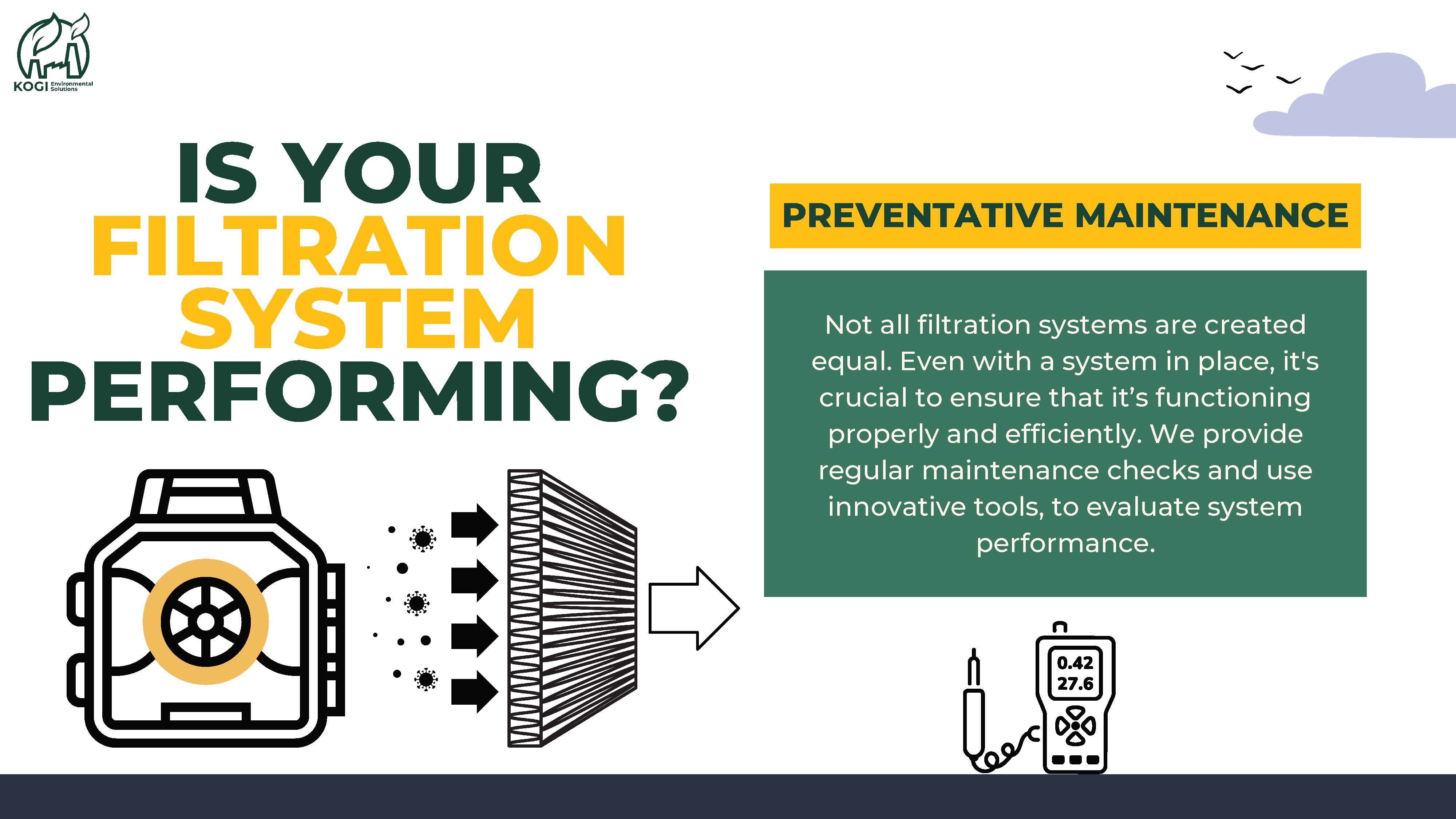
Kogi Environmental Solutions provides baghouse inspection and service, including testing, installation, refurbishment, start-up, and rebuild support. OEM-certified technicians can also evaluate fans, motors, controls, ducting, and replacement filter requirements.
Differential Pressure: The Primary Filter Performance Indicator
Differential pressure, or ΔP, measures the resistance created by the filter media as air passes through the collector. It is one of the most useful operating indicators for a cartridge dust collector.
A clean-filter baseline should be established after installing new filters or after a verified cleaning and inspection. The baseline must be recorded at a known airflow and under representative process conditions.
A rising ΔP can indicate:
- Normal dust loading
- Ineffective pulse-jet cleaning
- Low or wet compressed air
- Incorrect pulse timing
- Filter blinding
- Excessive dust loading
- Inadequate collector capacity
- A change in process material or production volume
A sudden decrease in ΔP can also indicate a problem. Possible causes include a damaged cartridge, a failed gasket, filter bypass, an open access door, or a breach in the filter media.
There is no universal filter-change pressure that applies to every industrial dust collector. The controlling value should come from the OEM and the system design. As a general maintenance practice, filter replacement should be evaluated when differential pressure remains elevated after proper pulse cleaning, airflow falls below the required operating range, or emissions and filter damage indicate media failure.
Over-cleaning should be avoided. Excessive pulse-jet activity can accelerate wear and increase compressed-air consumption. Demand-based cleaning, when supported by the collector controls, should maintain ΔP within the design operating range rather than continuously forcing the lowest possible reading.
Cartridge Dust Collector Filter Maintenance
Cartridge filters should be selected for the specific dust, temperature, humidity, particle size, and operating conditions. Filter construction, media treatment, pleat spacing, and gasket design all affect service life.
During inspection, look for:
- Holes, tears, or abrasion
- Uneven dust loading
- Moisture or condensation
- Oil or chemical contamination
- Collapsed or distorted pleats
- Damaged gaskets
- Dust on the clean-air side of the cartridge
- Excessive dust release during pulse cleaning
A replacement cartridge should match the collector’s dimensions, sealing arrangement, media requirements, and airflow design. Substituting a filter with a different configuration can change pressure drop, cleaning behavior, and emissions performance.
Kogi Environmental Solutions sources cartridge and baghouse filters from manufacturers including BHA, Parker Hannifin, Camfil, Donaldson, and other filtration suppliers. Filter identification should include the collector manufacturer, model, serial number, part number, dimensions, and media specification when available.
Pulse-Jet Cleaning and Compressed Air
Pulse-jet cleaning removes accumulated dust from cartridge or bag surfaces by releasing short bursts of compressed air. Weak or inconsistent pulses allow dust to build up. Excessive pulsing can damage media and shorten filter life.
Maintenance checks should confirm:
- Correct manifold pressure
- Dry, clean compressed air
- Proper solenoid operation
- Diaphragm valve integrity
- Correct pulse duration and interval
- Proper blow-tube alignment
- Intact venturis and fittings
- Normal sequence across all cleaning zones
Compressed-air dryers and filters are part of the dust collector maintenance system. Moisture can cause sticky dust, filter blinding, corrosion, and poor dust release. Where the facility uses a dedicated compressor and dryer, those components should be included in the collector’s preventive-maintenance records.
Ducting, Capture, and Fan Performance
A properly maintained filter cannot compensate for inadequate source capture. A dust collection system must maintain the required airflow from the hood through the ductwork and collector.
Inspect the following:
- Hood position and enclosure condition
- Branch dampers and blast gates
- Flexible duct connections
- Main duct velocity
- Elbows, transitions, and abrasion points
- Fan rotation and belt condition
- Static pressure at relevant measurement points
- Unused or modified pickup points
- Dust accumulation inside horizontal duct sections
Changes to production equipment, duct routing, hood configuration, or the number of operating pickup points can alter the system balance. A system that previously performed acceptably may require a duct design review or fan evaluation after a production-line expansion.
Kogi Environmental Solutions provides duct design and delegated design services, including 3D duct layouts, bills of materials, and system recommendations based on facility drawings and process requirements.
OSHA, NFPA, and EPA Considerations
Dust collector maintenance supports several regulatory and consensus-standard requirements. The applicable requirements depend on the material, process, facility, and air permit.
- OSHA 29 CFR 1910.94 addresses ventilation and includes requirements related to the removal and handling of accumulated contaminants.
- OSHA 29 CFR 1910.1000 establishes permissible exposure limits for specified air contaminants.
- OSHA’s combustible-dust guidance emphasizes inspection, housekeeping, dust-control procedures, leak prevention, and written programs.
- NFPA 652 establishes fundamentals for combustible-dust hazard analysis and management.
- NFPA 654 addresses prevention of fire and dust explosions from the manufacturing, processing, and handling of combustible particulate solids.
- EPA NESHAP requirements may apply where a process emits hazardous air pollutants and is covered by an applicable source category or air permit.
OSHA does not establish one universal cartridge replacement interval for every dust collector. Facilities should document inspections, corrective actions, airflow checks, differential-pressure readings, filter changes, and combustible-dust housekeeping activities. Air quality monitoring can help determine whether airborne concentrations remain within applicable exposure limits.
MERV 11 filters may be appropriate for certain HVAC or general ventilation applications, but a MERV rating alone does not specify suitability for an industrial dust collector. Cartridge dust collectors require filters engineered for the dust loading, airflow, temperature, pressure drop, and cleaning method of the process.

Housekeeping and Combustible Dust Controls
Dust accumulation outside the collector may indicate a leak, inadequate capture, poor discharge sealing, or an unsuitable housekeeping method. Open and hidden surfaces should be inspected according to the facility’s combustible-dust hazard assessment.
Maintenance programs should define:
- Approved vacuum equipment
- Prohibited cleaning methods that disperse dust clouds
- Inspection frequencies for elevated and concealed areas
- Procedures for collector shutdowns
- Dust-container handling and disposal
- Ignition-source controls
- Training responsibilities
- Escalation procedures for abnormal accumulation
Compressed-air blowdown should not be used where it can suspend combustible or hazardous dust. The appropriate cleaning method depends on the dust hazard classification and facility procedures.
Documentation and Annual Performance Review
A complete annual review should compare maintenance records with actual system performance. The review should include:
- Differential-pressure trends and filter change history
- Airflow and static-pressure measurements
- Pulse-jet repairs and compressed-air conditions
- Fan, motor, and bearing maintenance
- Duct and hood inspection findings
- Dust-leak and housekeeping observations
- Air quality monitoring results
- Changes in production materials, equipment, or operating hours
- Corrective actions that remain open
The result should be a prioritized maintenance plan for the next operating period. Where the system no longer meets the process requirement, the appropriate response may involve filter replacement, pulse-system repair, fan balancing, duct modification, collector capacity review, or a full air quality assessment.
An industrial dust collector is a process-control system, not an isolated piece of equipment. Consistent inspections, measured performance, correct replacement filters, controlled pulse cleaning, maintained ductwork, and documented combustible-dust procedures provide the foundation for reliable operation and OSHA compliance in 2026.
Industrial dust collector maintenance affects capture performance, filter life, energy use, equipment reliability, and workplace exposure control. A maintenance program for 2026 should evaluate the complete system: capture hoods, ducting, fan performance, filters, pulse-jet cleaning, discharge equipment, controls, and combustible-dust safeguards.
The objective is not simply to replace filters on a fixed schedule. Maintenance decisions should be based on differential-pressure trends, airflow measurements, filter condition, dust characteristics, and the requirements of the original equipment manufacturer (OEM).
Industrial Dust Collector Maintenance Schedule
A written schedule should define operator-level checks, maintenance tasks, responsible personnel, and escalation procedures. The following framework applies to most cartridge dust collectors and can be adapted for baghouse systems.
Daily Checks
Daily inspections should be completed while the system is operating under normal production conditions.
- Record differential pressure across the dust collector filters.
- Confirm suction at each hood or pickup point.
- Check for visible dust emissions around doors, access panels, duct joints, and discharge points.
- Inspect hopper or drum levels before collected dust reaches the maximum operating level.
- Listen for abnormal fan, motor, rotary valve, or pulse-jet sounds.
- Verify that alarms, pressure indicators, and control panels show normal operation.
- Check for changes in dust accumulation near the collector, ductwork, or production equipment.
A single differential-pressure reading is less useful than a consistent trend. Readings should be recorded with the production process, operating hours, and any changes in material or workload noted.
Weekly Checks
Weekly inspections should include the accessible mechanical and pneumatic components of the system.
- Inspect cartridge filters or bags for visible damage, heavy caking, oil contamination, or abnormal dust loading.
- Check filter access doors and gaskets for air leakage.
- Verify operation of pulse valves, solenoids, diaphragm valves, and compressed-air regulators.
- Inspect the pulse manifold for leaks and confirm that all cleaning zones are cycling.
- Check duct connections, flexible connectors, and clamps for dust leakage.
- Inspect the hopper discharge mechanism, rotary airlock, or collection drum interface.
- Review the differential-pressure log for a steady increase or unusual fluctuation.
Monthly and Quarterly Checks
Monthly maintenance should include a more detailed review of cleaning performance and compressed-air quality. Quarterly or semiannual inspections should evaluate the complete air-handling system.
- Verify compressed-air pressure against the OEM specification.
- Confirm that compressed air is dry and free from excessive oil or water.
- Inspect air dryers, coalescing filters, and compressed-air drains.
- Test pulse timing, duration, and sequence.
- Inspect fan belts, bearings, guards, couplings, and motor condition.
- Measure system airflow and static pressure where performance has changed.
- Inspect ductwork for abrasion, corrosion, dust buildup, and unsupported sections.
- Check structural supports, access doors, hopper transitions, and explosion-protection components where applicable.
- Inspect cartridges or bags for wear, poor dust release, and evidence of bypass.
Kogi Environmental Solutions provides baghouse inspection and service, including testing, installation, refurbishment, start-up, and rebuild support. OEM-certified technicians can also evaluate fans, motors, controls, ducting, and replacement filter requirements.
Differential Pressure: The Primary Filter Performance Indicator
Differential pressure, or ΔP, measures the resistance created by the filter media as air passes through the collector. It is one of the most useful operating indicators for a cartridge dust collector.
A clean-filter baseline should be established after installing new filters or after a verified cleaning and inspection. The baseline must be recorded at a known airflow and under representative process conditions.
A rising ΔP can indicate:
- Normal dust loading
- Ineffective pulse-jet cleaning
- Low or wet compressed air
- Incorrect pulse timing
- Filter blinding
- Excessive dust loading
- Inadequate collector capacity
- A change in process material or production volume
A sudden decrease in ΔP can also indicate a problem. Possible causes include a damaged cartridge, a failed gasket, filter bypass, an open access door, or a breach in the filter media.
There is no universal filter-change pressure that applies to every industrial dust collector. The controlling value should come from the OEM and the system design. As a general maintenance practice, filter replacement should be evaluated when differential pressure remains elevated after proper pulse cleaning, airflow falls below the required operating range, or emissions and filter damage indicate media failure.
Over-cleaning should be avoided. Excessive pulse-jet activity can accelerate wear and increase compressed-air consumption. Demand-based cleaning, when supported by the collector controls, should maintain ΔP within the design operating range rather than continuously forcing the lowest possible reading.
Cartridge Dust Collector Filter Maintenance
Cartridge filters should be selected for the specific dust, temperature, humidity, particle size, and operating conditions. Filter construction, media treatment, pleat spacing, and gasket design all affect service life.
During inspection, look for:
- Holes, tears, or abrasion
- Uneven dust loading
- Moisture or condensation
- Oil or chemical contamination
- Collapsed or distorted pleats
- Damaged gaskets
- Dust on the clean-air side of the cartridge
- Excessive dust release during pulse cleaning
A replacement cartridge should match the collector’s dimensions, sealing arrangement, media requirements, and airflow design. Substituting a filter with a different configuration can change pressure drop, cleaning behavior, and emissions performance.
Kogi Environmental Solutions sources cartridge and baghouse filters from manufacturers including BHA, Parker Hannifin, Camfil, Donaldson, and other filtration suppliers. Filter identification should include the collector manufacturer, model, serial number, part number, dimensions, and media specification when available.
Pulse-Jet Cleaning and Compressed Air
Pulse-jet cleaning removes accumulated dust from cartridge or bag surfaces by releasing short bursts of compressed air. Weak or inconsistent pulses allow dust to build up. Excessive pulsing can damage media and shorten filter life.
Maintenance checks should confirm:
- Correct manifold pressure
- Dry, clean compressed air
- Proper solenoid operation
- Diaphragm valve integrity
- Correct pulse duration and interval
- Proper blow-tube alignment
- Intact venturis and fittings
- Normal sequence across all cleaning zones
Compressed-air dryers and filters are part of the dust collector maintenance system. Moisture can cause sticky dust, filter blinding, corrosion, and poor dust release. Where the facility uses a dedicated compressor and dryer, those components should be included in the collector’s preventive-maintenance records.
Ducting, Capture, and Fan Performance
A properly maintained filter cannot compensate for inadequate source capture. A dust collection system must maintain the required airflow from the hood through the ductwork and collector.
Inspect the following:
- Hood position and enclosure condition
- Branch dampers and blast gates
- Flexible duct connections
- Main duct velocity
- Elbows, transitions, and abrasion points
- Fan rotation and belt condition
- Static pressure at relevant measurement points
- Unused or modified pickup points
- Dust accumulation inside horizontal duct sections
Changes to production equipment, duct routing, hood configuration, or the number of operating pickup points can alter the system balance. A system that previously performed acceptably may require a duct design review or fan evaluation after a production-line expansion.
Kogi Environmental Solutions provides duct design and delegated design services, including 3D duct layouts, bills of materials, and system recommendations based on facility drawings and process requirements.
OSHA, NFPA, and EPA Considerations
Dust collector maintenance supports several regulatory and consensus-standard requirements. The applicable requirements depend on the material, process, facility, and air permit.
- OSHA 29 CFR 1910.94 addresses ventilation and includes requirements related to the removal and handling of accumulated contaminants.
- OSHA 29 CFR 1910.1000 establishes permissible exposure limits for specified air contaminants.
- OSHA’s combustible-dust guidance emphasizes inspection, housekeeping, dust-control procedures, leak prevention, and written programs.
- NFPA 652 establishes fundamentals for combustible-dust hazard analysis and management.
- NFPA 654 addresses prevention of fire and dust explosions from the manufacturing, processing, and handling of combustible particulate solids.
- EPA NESHAP requirements may apply where a process emits hazardous air pollutants and is covered by an applicable source category or air permit.
OSHA does not establish one universal cartridge replacement interval for every dust collector. Facilities should document inspections, corrective actions, airflow checks, differential-pressure readings, filter changes, and combustible-dust housekeeping activities. Air quality monitoring can help determine whether airborne concentrations remain within applicable exposure limits.
MERV 11 filters may be appropriate for certain HVAC or general ventilation applications, but a MERV rating alone does not specify suitability for an industrial dust collector. Cartridge dust collectors require filters engineered for the dust loading, airflow, temperature, pressure drop, and cleaning method of the process.
Housekeeping and Combustible Dust Controls
Dust accumulation outside the collector may indicate a leak, inadequate capture, poor discharge sealing, or an unsuitable housekeeping method. Open and hidden surfaces should be inspected according to the facility’s combustible-dust hazard assessment.
Maintenance programs should define:
- Approved vacuum equipment
- Prohibited cleaning methods that disperse dust clouds
- Inspection frequencies for elevated and concealed areas
- Procedures for collector shutdowns
- Dust-container handling and disposal
- Ignition-source controls
- Training responsibilities
- Escalation procedures for abnormal accumulation
Compressed-air blowdown should not be used where it can suspend combustible or hazardous dust. The appropriate cleaning method depends on the dust hazard classification and facility procedures.
Documentation and Annual Performance Review
A complete annual review should compare maintenance records with actual system performance. The review should include:
- Differential-pressure trends and filter change history
- Airflow and static-pressure measurements
- Pulse-jet repairs and compressed-air conditions
- Fan, motor, and bearing maintenance
- Duct and hood inspection findings
- Dust-leak and housekeeping observations
- Air quality monitoring results
- Changes in production materials, equipment, or operating hours
- Corrective actions that remain open
The result should be a prioritized maintenance plan for the next operating period. Where the system no longer meets the process requirement, the appropriate response may involve filter replacement, pulse-system repair, fan balancing, duct modification, collector capacity review, or a full air quality assessment.
An industrial dust collector is a process-control system, not an isolated piece of equipment. Consistent inspections, measured performance, correct replacement filters, controlled pulse cleaning, maintained ductwork, and documented combustible-dust procedures provide the foundation for reliable operation and OSHA compliance in 2026.
Artículos recientes


← Publicación más antigua Publicación más reciente →